
Reviewed · KUMASI CULTURAL TOURS
One day tour at Kumasi
The most memorable part of this Kumasi tour is the way it links royal power, sacred tradition, military history, and everyday craft. In one day, you can see the immovable sword of Okomfo Anokye, royal objects connected with Prempeh II, and the hands-on work behind Adinkra and Kente cloth.
I like the private format, since your guide can adjust the pace and respond to your interests. I also like the mix of museums and working craft villages, especially the chance to try Kente weaving and Adinkra printing. The main drawback is time: seven stops spread across Kumasi and nearby villages can make the day feel full, and lunch is not included.
Key points to know before booking
- The tour connects major Asante sites: You visit Manhyia Palace Museum, Kumasi Fort, Prempeh II Museum, and the Okomfo Anokye Sword Site.
- Craft is part of the experience: Ntonso explains traditional Adinkra production, while Adanwomase focuses on Kente weaving and symbolic patterns.
- You finish at Kejetia Market: This is the place for local goods, souvenirs, and a direct look at Kumasi’s commercial life.
- Private transport keeps the day practical: An air-conditioned vehicle and pickup service make it easier to cover several locations.
- Guides can tailor the day: Past arrangements included extra requests such as visiting the Akwasidae festival, and guides named Jones, Josephine, and Godfrey have handled flexible tours.
- Plan around the pace: The listed stops add up to more than four hours before driving time, shopping, and any meal break.
Why this Kumasi route works
Kumasi is the historic center of Asante culture, and this route gives you several ways to understand it. You begin with the royal court, move into military and spiritual history, then finish with cloth production and the city market.
That order makes sense. The first museums explain the institutions and people who shaped the Asante Kingdom. The craft villages then show how symbols, clothing, and handmade goods continue to carry meaning today.
I would not treat this as a museum-only excursion. It is better understood as a cultural survey with short, focused stops. Some museums are small, but they add up to a useful picture when visited together.
The tour costs $130 per person. That is not a bargain-basement city outing, but the price includes an air-conditioned vehicle, admission fees where listed, taxes, and private service. You are paying for coverage and flexibility as much as for entry tickets. If you are traveling with a small group and want to see several places without arranging separate taxis, the value is easier to see.
The tour begins at 8:00 a.m. at Manhyia Palace Museum and ends at Kejetia New Market and Bus Terminal. Pickup is offered, so confirm the exact pickup plan when booking. The total duration is about four to eight hours, depending on traffic, time at the craft villages, and how much shopping or discussion you add.
More kumasi cultural tours in Kumasi:
- Tour Kumasi City Like a Local
★ 4.5 · 34 reviews - Traditional naming ceremony For African Diasporas in Kumasi
★ 5.0 · 10 reviews - Kumasi City Tour
★ 5.0 · 8 reviews
Manhyia Palace Museum and the Asante royal court
Manhyia Palace Museum is the natural starting point. The museum opened in 1995 during the Silver Jubilee celebration of the accession of the Golden Stool, an object central to Asante identity.
You have about 45 minutes here, with admission included. The museum is small, but the collection includes historic objects, war amulets, and other items linked to the Asante Kingdom. That compact size can work in your favor. You are not trying to cover a huge building in a rush, and a guide can help connect the objects to the royal court.
Pay attention to the difference between ordinary historical objects and items with royal or spiritual meaning. The war amulets, in particular, point to a world in which political authority, warfare, and religious belief were closely tied.
This is not the place for a long, self-guided museum session. Your 45 minutes will go quickly, so ask questions early if you have a special interest in royal succession, military tradition, or the Golden Stool.
Kumasi Fort and the Ghana Armed Forces Museum
The next stop shifts the focus from the palace to warfare and the modern history of Ghana. The Ghana Armed Forces Museum occupies Kumasi Fort and holds military equipment and artifacts connected with the British-Asante war and the Second World War.
You spend about an hour here, and admission is included. The collection includes weapons, military colors, medals, armored cars, portraits, and photographs. These objects help you trace the country’s changing military and political story from the colonial period to the present.
I find this stop useful because it adds a harder edge to the royal story. The palace museums present authority through ceremony, lineage, and symbols. The fort shows how power was tested through conflict and how Ghana’s institutions changed over time.
Allow yourself time to look closely at the photographs and personal objects. A display of medals can be easy to skim, but the portraits and images often give the history a more human scale.
The museum may appeal most to people interested in military history, colonial history, or Ghana’s independence-era development. If your main interest is cloth, food, or architecture, this could be the most demanding stop, but the hour is still reasonable.
Prempeh II Museum and royal household details
Prempeh II Museum offers a more personal look at Asante royalty. Its displays relate to King Prempeh II and include war clothing, ceremonial dress, jewelry, protective amulets, bathing and dining equipment, furniture, royal insignia, and brass weights used to weigh gold.
The visit lasts about 25 minutes, with a personalized tour included in admission. The museum was built to resemble an Ashanti chief’s house, with a front courtyard and walls decorated with traditional carved symbols.
The small scale is part of its appeal. Instead of seeing royal life only through major political events, you get details about clothing, meals, bathing, protection, and household objects. Those details help you picture how status was displayed and maintained.
The brass gold weights deserve a close look. They connect daily commerce with artistry and symbolism. Since the stop is short, keep your attention on the guide’s explanation rather than trying to rush through every object.
This museum overlaps with Manhyia Palace Museum, but the two do different jobs. Manhyia introduces the wider royal institution. Prempeh II gives you a closer look at one king and the objects around his life.
A few more Kumasi trips to weigh up
- One Day Tour To Cape Coast, Elmina Castle, Kakum National Park
★ 5.0 · 21 reviews - From Accra: Cape Coast and Elmina Castles Day Trip
★ 5.0 · 19 reviews - Accra: Shai Hills and Volta River Cruise Day Trip with Lunch
★ 4.8 · 11 reviews - 1 Day cocoa farm tour
★ 4.5 · 11 reviews
The Okomfo Anokye Sword Site
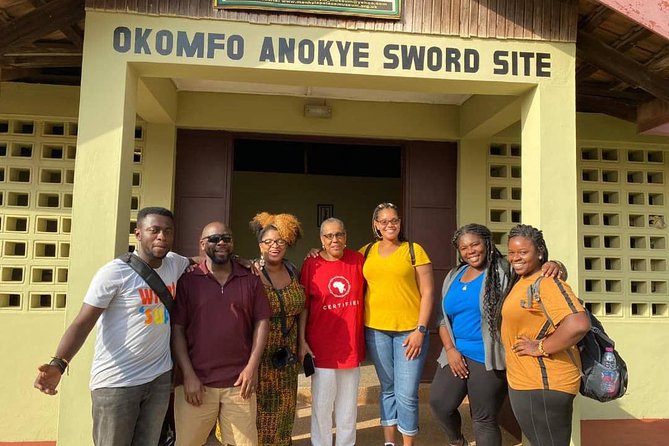
The Okomfo Anokye Sword Site is a brief but important stop. You spend about 15 minutes at the small museum surrounding the sword said to have been driven into the ground by Okomfo Anokye and made immovable.
The site matters because Okomfo Anokye is tied to the founding traditions of the Asante state. Even with only a short visit, the sword gives you a physical point of reference for a story that otherwise lives in oral tradition and historical accounts.
Do not expect a large museum or a long visit. This is a focused stop built around one object and its meaning. I would treat it as a pause for context rather than a major sightseeing block.
The site also helps balance the earlier museums. After seeing military equipment and royal belongings, you encounter an object whose importance is spiritual and symbolic. That range is one of the tour’s strengths.
Ntonso and the making of Adinkra cloth
At Ntonso Adinkra Cloth Village, the tour turns from preserved objects to active craft. Ntonso is known as the homeland of Adinkra cloth and as the only place in Ghana where traditional Adinkra is made locally from scratch.
You have about 50 minutes here, with admission included. The stop is not just a shopping break. Adinkra cloth is known for its symbols and proverbial meanings, so the value lies in seeing how the designs are produced and understanding that the patterns communicate more than decoration.
One of the most useful parts of the tour is the chance to try Adinkra symbol printing. This gives you a better sense of the process than simply buying a finished piece from a shop.
You will likely find locally made cloth and other goods available for purchase. Take your time before buying. Compare patterns, ask what a symbol means, and decide if you want a practical souvenir or a decorative textile.
The village can feel more hands-on than the museum stops, but the visit is still fairly short. If craft is your main reason for booking, tell the guide at the start so you have enough time for questions and shopping.
Adanwomase and the meaning of Kente
The stop at Adanwomase lasts about an hour and focuses on Kente cloth. Kente has long been worn by African kings, and the cloth is still made in the traditional way in this Ashanti community.
Kente is valued for its striking designs, but the patterns also carry meaning. There are more than 300 patterns, each with a name and an association with proverbs, historical events, important chiefs, or useful plants.
You may get to try Kente weaving here. That matters because the narrow woven strips are not produced as a single wide sheet. Seeing the work up close helps you understand the time and skill behind a finished garment.
The hour gives you more room than the Adinkra stop, although it still includes travel and the possibility of shopping. If you want to purchase Kente, ask about the pattern’s meaning and how the cloth was made. A piece with a known story is a better souvenir than one chosen only by color.
The two villages complement one another. Adinkra centers on stamped symbols and proverbial wisdom. Kente combines color, pattern, weaving skill, and named designs. Together, they show how cloth can function as history, status, language, and art.
Kejetia Market, the final stop in Kumasi
The tour ends with about an hour at Kejetia Market, also called Kumasi Central Market. This open-air market is in the heart of Kumasi and gives you a sharp change of pace after the quieter museums and craft villages.
Kejetia is the place to shop for locally made goods and souvenirs, but it is also valuable simply as a look at daily commerce. You will see a side of Kumasi that a palace museum cannot provide.
The market is a practical end point because you can continue on from Kejetia New Market and Bus Terminal. It also means your tour does not return you to the starting point, so plan your next move before the day begins.
One hour is enough for a first look, but it can feel short if you want to shop seriously. Keep your purchases manageable, stay aware of your belongings, and agree with your guide on where and when to regroup.
Lunch is not included. Kejetia may offer food options, but the tour details do not promise a meal or specify a restaurant. Ask about the meal plan at the start, particularly if you prefer a proper sit-down break rather than eating between stops.
Private guiding and the human side of the day
The private format is one of the clearest reasons to choose this experience. Only your group participates, so you can ask more questions and spend extra time at a place that matters to you.
The tour team has included guides and drivers named Jones, Josephine, Godfrey, and Kofi in past arrangements. Jones was especially flexible with requests and helped combine museum visits with Kente weaving and Adinkra printing. Josephine handled a research-focused visit and adjusted the schedule to suit specific needs.
That flexibility can be useful in Kumasi. You may care most about royal history, military objects, textile production, or shopping. A private guide can help you give more time to your priority instead of following a fixed group pace.
Extra arrangements have also included a request to visit the Akwasidae festival. That does not mean the festival is part of this standard tour, so you should ask in advance if you hope to add a special event or site.
The strongest praise for the tour team centers on communication, personal care, and willingness to adjust plans. Several longer experiences with the company also described the owner, Kofi, as personable and attentive. Those qualities matter on a full day with several moving parts.
Timing, transport, and who should book
The air-conditioned vehicle is a practical inclusion. Kumasi’s route involves several stops, including villages outside the central museum area, so private transport saves you from arranging separate rides.
The stated duration is four to eight hours. The formal stop times total roughly four hours and 15 minutes, before driving, traffic, shopping, lunch, and questions. In practice, I would protect the longer end of that range and avoid scheduling a tight appointment immediately afterward.
The start point is Manhyia Palace Museum at 8:00 a.m., with pickup offered. The finish is Kejetia New Market and Bus Terminal. Most people can participate, service animals are allowed, and the tour is near public transportation.
This tour suits you best if you want:
- A broad introduction to Asante culture in one day
- Private transportation and a guide focused on your group
- A mix of museums, sacred sites, craft work, and shopping
- Time with Adinkra and Kente rather than museums alone
- Help arranging a flexible cultural schedule
It may not suit you if you want a slow museum day, a food-focused tour, or a short city walk. Seven stops create variety, but they also create a busy rhythm.
Is the $130 price fair?
At $130 per person, the tour makes the most sense when you value private transport and a full route. Admission is included at the main museum stops, and the vehicle is air-conditioned. You also avoid the time and uncertainty of arranging transport between central Kumasi, Ntonso, Adanwomase, and Kejetia.
The price is less compelling if you plan to visit only the central museums or prefer to arrange each site independently. It also does not include lunch, and shopping costs are separate.
For a couple, family, or small private group, I think the convenience can justify the price. The best value comes from using the private format well: ask questions, request a little extra time at the craft villages, and tell the guide what matters most to you.
Free cancellation is available if you cancel at least 24 hours before the 8:00 a.m. start. Changes made within 24 hours are not accepted, and there is no refund inside that period. Since the tour requires good weather, a weather cancellation brings either another date or a full refund.
Should you book this Kumasi tour?
Book it if you want one well-organized day that moves from Asante kings and military history to living craft traditions and the city market. The strongest feature is the combination of places: no single stop tells the whole story, but together they give you a useful sense of Kumasi.
I would especially recommend it for first-time visitors, families, small groups, and anyone who wants a private guide. Mention your interests before the day begins, since the team has shown it can adjust for research needs, festival visits, weaving, printing, and extra cultural requests.
Skip it if you dislike a full schedule or want to explore each museum at length. For everyone else, $130 buys a practical introduction to Kumasi with meaningful context, hands-on craft, and a final hour among the shops and streets of Kejetia.
FAQ
How long does the Kumasi tour last?
The tour lasts approximately four to eight hours. The duration can vary with driving time, traffic, shopping, questions, and the pace of your private group.
What time does the tour start?
The scheduled start time is 8:00 a.m. The starting point is Manhyia Palace Museum in Kumasi, and pickup is offered.
Where does the tour end?
The tour ends at Kejetia New Market and Bus Terminal in Kumasi, at the Kejetia market.
Is the tour private?
Yes. Only your group participates, allowing the schedule and discussion to be more personal.
Is transportation included?
Yes. The tour includes an air-conditioned vehicle.
Is lunch included?
No. Lunch is not included in the tour price.
Are admission fees included?
All fees and taxes are included. Admission is specifically included for Manhyia Palace Museum, Kumasi Fort, Prempeh II Museum, the Okomfo Anokye Sword Site, and Ntonso. Adanwomase has no admission fee listed, while Kejetia Market admission is not included.
What is the cancellation policy?
You receive a full refund if you cancel at least 24 hours before the experience start time. Cancellations or changes made less than 24 hours before the start are not accepted and are not refunded. If poor weather causes the tour to be canceled, you are offered another date or a full refund.
Just added around Kumasi
- Kumasi Culture and Heritage Tours★ 4.5 · 3 reviews
- Traditional Naming Ceremony For African Americans In Kumasi★ 5.0 · 5 reviews
- Full Day Tour with Traditional Naming Ceremony in Kumasi★ 5.0 · 4 reviews
- Discover kumasi Tours★ 5.0 · 3 reviews
- Kumasi City Tour★ 4.5 · 3 reviews
- Kumasi: City Tour★ 5.0 · 3 reviews
- Lake Bosomtwe Boat Cruisely and Kumasi City Tours★ 4.5 · 6 reviews
- Kumasi City Tour★ 4.5 · 7 reviews
Kumasi Cultural Tours, compared.
Kumasi Heritage Tours And Naming Ceremony In A Day
Read our review →
Traditional naming ceremony For African Diasporas in Kumasi
Read our review →
Full-Day Tour to Ashanti Region, Kumasi and Ghanaian History
Read our review →

Lake Bosomtwe Boat Cruisely and Kumasi City Tours
Read our review →
4 Days Trip in Accra, Cape Coast,Kumasi culture & heritage tours
Read our review →Browse the lists this tour appears in