

Reviewed · CITY TOURS
Half-Day City Tour of Accra
Accra’s story comes into focus through its public places. In five hours, this tour moves from the Black Star Gate and Independence Arch to the mausoleum of Kwame Nkrumah, then into craft stalls, James Town, and the busy trading streets of Makola Market. It gives you a quick but broad look at Ghana’s capital.
I like the strong mix of subjects: independence history and political memory sit alongside arts, shopping, and everyday city life. I also like that guides such as Charles, Noble, and Christ add personal explanation rather than leaving you to simply photograph monuments. The main drawback is the pace. Six stops in five hours leaves little room to linger, and Makola Market or the Arts Center could easily fill much of an afternoon on its own.
Key points to know before you book
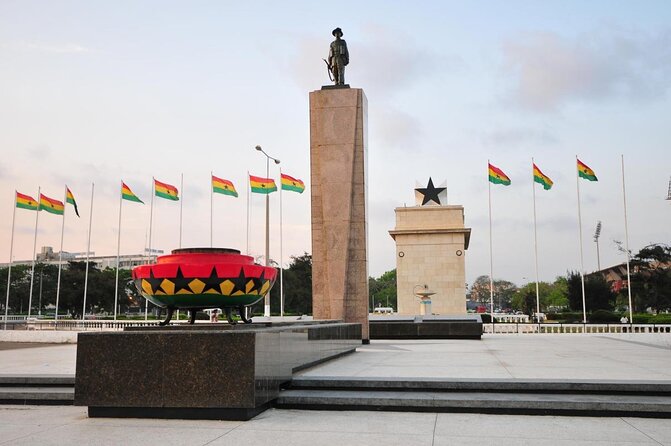
- Six major Accra stops in five hours: The route covers national monuments, memorial parks, a museum, crafts, a lighthouse, and a central market.
- History is the main thread: Independence Square and Kwame Nkrumah Memorial Park connect Ghana’s national story with the wider African struggle for independence.
- Guiding adds useful context: Charles, Noble, and Christ are among the guides named in the tour’s feedback, with museum explanations receiving particular praise.
- The Arts Center and Makola Market add local life: These stops move the day beyond monuments and into shopping, crafts, and commerce.
- The price is $100 per person: Admission fees, taxes, and bottled water are included, which makes the cost easier to assess.
- A fixed meeting point keeps things simple: You start and finish at Accra Sports Stadium, with a maximum group size of 30.
A five-hour introduction to Accra
This is a good choice if you want your first look at Accra organized around the city’s major themes. The route is not limited to one type of sight. You get memorials, political history, a museum, local arts, a coastal neighborhood landmark, and a market.
That variety matters. A tour made up only of monuments can feel distant from daily life. A market-only outing may show you activity without explaining how Ghana became the country it is today. Here, the stops are linked by the story of Ghana’s independence, its leaders, its public culture, and its commercial life.
The five-hour schedule is full, with one hour assigned to Independence Square, 30 minutes at Asomdwe Park, 30 minutes at Kwame Nkrumah Memorial Park, one hour at the Center for National Culture, one hour at James Town Lighthouse, and one hour at Makola Market. The timing adds up neatly, but it also tells you to expect a brisk outing.
You should think of this as an overview rather than a slow, highly detailed visit to each place. It works especially well early in a stay, when you want a sense of Accra’s layout and the subjects you may want to explore later.
A few more Accra trips to weigh up
- Half-Day Private History Tour in Nkyinkyim Museum
★ 5.0 · 9 reviews - Half-day Accra Guided Tour
★ 4.5 · 8 reviews - Half-day Accra Safari Tour
★ 4.5 · 6 reviews
Independence Square and the Black Star Gate

The tour begins with one of the clearest symbols of modern Ghana. Independence Square, also known as Black Star Square, contains monuments tied to the country’s independence struggle.
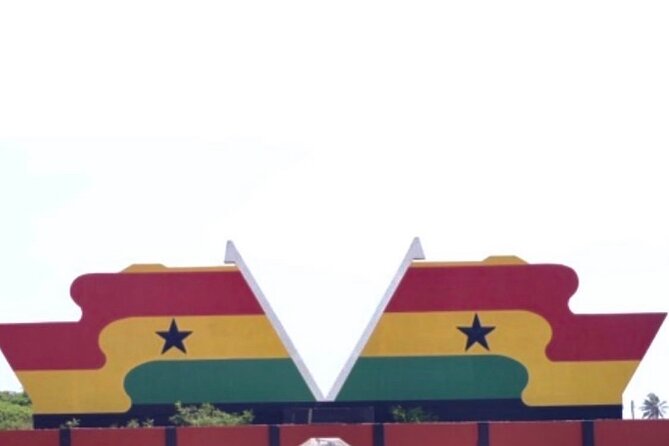
Your guide explains the Independence Arch, the Black Star Gate, and the Liberation Day Monument. These are not random photo stops. Together, they point to Ghana’s national identity and the importance of the independence movement in the country’s public life.
The one-hour allocation gives this opening stop more weight than a quick drive-by. You have time to listen, look around, and ask questions about the monuments. This is also where a guide makes a real difference. Without context, a large ceremonial square can seem spare. With an explanation of the symbols and events connected to it, the space becomes easier to read.
I would pay close attention here if you are interested in politics, African history, or architecture used for national ceremonies. If you prefer small streets and close-up local encounters, the square may feel formal, but it provides the necessary opening chapter for the rest of the tour.
Asomdwe Park and the memory of J.E.A. Mills
The next stop is Asomdwe Park, a memorial park holding the mortal remains of former President J.E.A. Mills. The visit is scheduled for 30 minutes, so expect a short, focused stop rather than an extended park visit.
This adds a more recent layer of political memory to the tour. Independence Square looks at Ghana’s birth as an independent nation, while Asomdwe Park connects the route to the country’s later presidency and public leadership.
The shorter timing makes sense for a memorial stop, though it means you may not have much spare time if you want to examine every detail. I would treat this as a pause for reflection and explanation, not as one of the tour’s main sightseeing blocks.
Kwame Nkrumah Memorial Park and the independence story

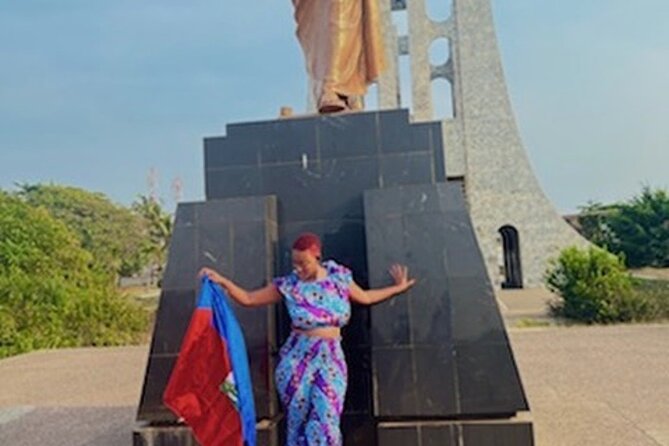
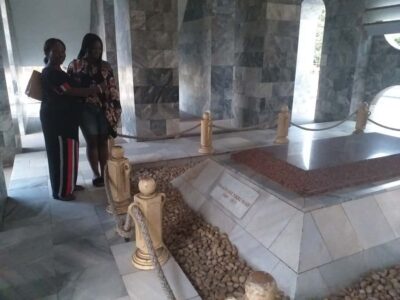
Kwame Nkrumah Memorial Park is one of the tour’s most important stops. The mausoleum is the final resting place of Ghana’s first President and Africanist, Kwame Nkrumah. The museum contains artifacts connected with Ghana’s independence and the wider sub-Saharan struggle for freedom from colonial rule.
The 30-minute schedule is short for a site with both a mausoleum and museum. Still, the stop gives you a useful framework for understanding the earlier visit to Independence Square. Nkrumah’s role connects national independence with Pan-African thought, a subject also highlighted by the guide’s explanation of W.E.B. Du Bois and his partnership with Ghana and the wider world.
This is one place where the quality of the explanation matters most. A brief museum visit can feel rushed if you are left to read everything alone. Guides named in the tour’s feedback, including Charles, Christ, and Noble, have been singled out for adding historical detail and making the visit more than a quick walk through displays.
If Nkrumah, Pan-Africanism, and the independence movements of Africa interest you, give this stop your full attention. You may want to return later for more time, since the scheduled half hour is best understood as an introduction.
Same coastline, a completely different kind of day:
- The Cape Coast Day Tour
★ 5.0 · 525 reviews - Experience the Beauty, History and the Culture Of Accra in a Day
★ 5.0 · 323 reviews - The Cape Coast Tour
★ 5.0 · 177 reviews - From Accra: Cape Coast, Elmina Castle & Kakum Park Day Tour
★ 4.6 · 144 reviews
Crafts and culture at the Center for National Culture
The Center for National Culture, commonly known as the Arts Center, changes the mood. After the formal monuments and memorials, you get a place focused on Ghanaian arts and crafts.
The tour allows one hour here. That is enough time to browse and get a sense of the products and creative traditions on offer, though the exact selection and shopping experience can vary. The stop gives you a chance to see objects connected with Ghanaian culture in a more commercial and hands-on setting.
I like this part of the route because it gives the historical material a more everyday counterpart. National identity is not only expressed in arches and memorials. It also appears in design, craft, decoration, and the objects people make and sell.
If you are thinking about buying something, keep the time limit in mind. You may need to make choices quickly, and the tour does not promise an extended shopping session. The Arts Center is best for browsing, asking your guide what you are seeing, and noting anything you would like to investigate later.
James Town Lighthouse and Accra’s coastal character
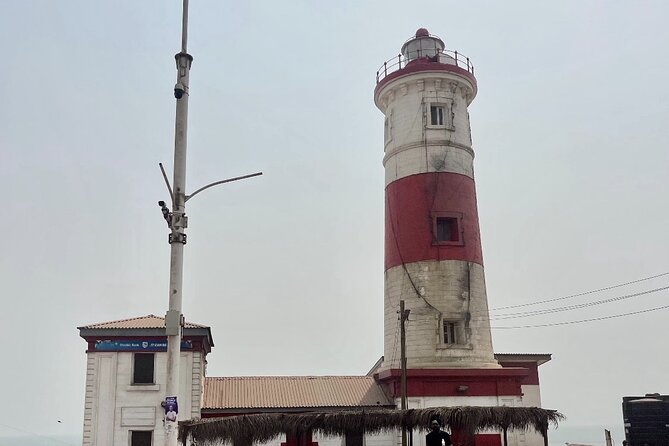
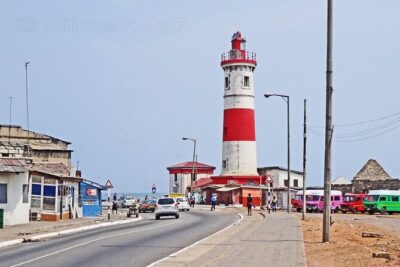
At James Town Lighthouse, you see a stone tower with a lantern and gallery attached to a keeper’s house. The stop has a full hour, making it one of the longer visits on the route.
The lighthouse gives the tour a change of scale. You move from national monuments and museum objects to a recognizable neighborhood landmark with a practical maritime function. The attached keeper’s house helps you picture the lighthouse as part of a working site rather than an isolated tower.
The supplied details do not promise that you will climb the tower or describe a particular view from the gallery, so you should not book this expecting a guaranteed ascent. The value is in seeing the structure, hearing its place in the local setting, and exploring James Town with a guide.
An hour here allows for a less hurried stop than at the two memorial sites. That balance is welcome, especially after the concentrated historical explanations earlier in the day.
Makola Market, from car parts to land snails
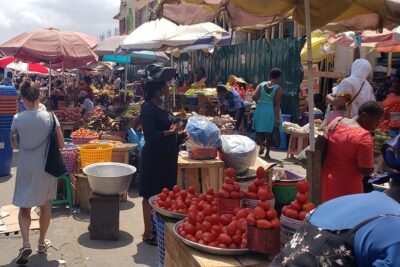
Makola Market is the tour’s strongest look at Accra’s commercial life. It is a major market and shopping district in the center of the capital, with goods sold both inside the market area and along surrounding streets.
The range is striking. You might find products as varied as car parts and land snails, along with many other goods. The point is not simply to shop. Makola helps you see how people buy, sell, move through, and use the city.
The one-hour visit gives you a taste of the market without making the entire tour about shopping. I would stay alert to the pace here, since a market can draw your attention in many directions at once. If you want to compare prices, search for particular items, or spend time making purchases, one hour may feel limited.
Still, this is an important final stop. It brings the tour back from national figures and formal memorials to the ordinary transactions that keep a capital city working. For many people, it may be the most memorable part of the day because it feels immediate and close to daily life.
How the guiding affects the experience

This tour depends heavily on its guide. The route includes places where a plaque or quick photograph will not tell you enough, particularly Independence Square and Kwame Nkrumah Memorial Park.
Charles is named as a guide who made a family tour informative and enjoyable. Noble and Charles are also named together in connection with a punctual, well-organized outing. Christ is praised for adding historical information during the museum visit, including material beyond what a visitor might notice alone.
The names are useful to know, but guide assignments can change. You should book for the structure and subject matter rather than expecting a specific person. The important point is that the tour is designed around explanation, and the strongest value comes when the guide links the monuments to Ghana’s independence, W.E.B. Du Bois, Pan-Africanism, and later national leadership.
A maximum of 30 people is allowed. That is not an intimate private tour, so the group could feel fairly large at the upper limit. On the other hand, a capped group is easier to manage than an open-ended public outing, and the fixed meeting point keeps the start and finish clear.
Is $100 per person fair value?
At $100 per person, this is not the cheapest way to see Accra. The price makes more sense if you value a guided route that combines six different types of stop in half a day.
All fees and taxes are included, as are admission tickets for the listed sites and bottled water. That reduces the need to sort out entry costs as you go. No meal is listed, so you should not treat the price as covering lunch or refreshments beyond the bottled water.
The value is strongest for a first visit, a short stay, or anyone who wants historical context without arranging separate outings. You are paying for the route, the guide’s explanations, the coordination of several stops, and access fees.
The value is weaker if you prefer to move slowly, spend hours shopping, or choose only one subject such as markets or Ghanaian independence. In that case, a broader half-day tour may feel rushed. You might get more from returning independently to one or two places after using this experience to decide what interests you most.
Timing, meeting point, and practical details
You meet at Accra Sports Stadium at 1272 Starlets 91 Road in Accra. The activity ends back at the same meeting point, which is useful if you need a clear return point rather than a drop-off at an unrelated location.
The listed time options are 9:00 AM to 12:00 PM, 12:30 PM to 3:30 PM, and 4:00 PM to 6:30 PM, from Monday through Sunday. The overall experience is described as approximately five hours, so confirm the exact departure slot when booking because the published time ranges do not each match a five-hour period.
A mobile ticket is provided. Confirmation is received at booking, and the tour operates near public transportation. Service animals are allowed, and most people can participate according to the supplied participation information.
The activity is non-refundable and cannot be changed for any reason. That makes it sensible to book only after your schedule is firm. Bottled water is included, but no other refreshments are specified.
Who should book the Accra city tour?
I would recommend this for a first-time visitor who wants a guided introduction to Accra’s major public landmarks. It is also a good fit if you have limited time and want history, culture, crafts, and market life in one organized outing.
The tour suits people who enjoy connecting places to political and social history. If W.E.B. Du Bois, Kwame Nkrumah, Pan-Africanism, and Ghana’s independence interest you, the explanations at the memorial and museum stops should be especially useful.
Families can also benefit from the variety. The route changes setting often enough to avoid one long museum visit, and the market and Arts Center provide a different kind of experience from the monuments.
I would hesitate if your main goal is a slow shopping trip, a private tour, or extended time at each site. A group of up to 30 and a five-hour schedule mean you will follow the planned route rather than shape every stop around your own interests.
Should you book it?
Book this tour if you want a broad, guided first look at Accra and value the link between national history and present-day city life. The combination of Independence Square, Nkrumah’s memorial, the Arts Center, James Town, and Makola Market gives you more range than a monument-only tour.
Skip it if you already know Accra well or prefer to spend a full afternoon at one market, museum, or neighborhood. At $100, the tour earns its price through variety, included admissions, and historical explanation, not through extra free time. For a newcomer with five hours to spare, that trade is reasonable.
FAQ
How long does the Accra city tour last?
The experience lasts approximately five hours.
How much does the tour cost?
The listed price is $100 per person.
Where does the tour begin?
The meeting point is Accra Sports Stadium, 1272 Starlets 91 Road, Accra, Ghana.
Where does the tour finish?
The activity ends back at the meeting point at Accra Sports Stadium.
Which places are visited?
The tour visits Independence Square, Asomdwe Park, Kwame Nkrumah Memorial Park, the Center for National Culture, James Town Lighthouse, and Makola Market.
Are admission fees included?
Yes. Admission tickets for the listed stops are included, along with all fees and taxes.
Is bottled water provided?
Yes. Bottled water is included.
How large can the group be?
The tour allows a maximum of 30 travelers.
Can I cancel or change the booking?
No. The experience is non-refundable and cannot be changed for any reason.
Just added around Accra
- Visit Aburi Garden, Tetteh Quarshie Cocoa Farm & Waterfall★ 4.0 · 4 reviews
- Historical Day Tour to Cape Coast, Elmina and Kakum★ 5.0 · 3 reviews
- Private Airport Transfer to from ACC Kotoka by Business Car★ 5.0 · 4 reviews
- Private Slave Castles and Dungeons Tour in Cape Coast, Ghana★ 5.0 · 3 reviews
- Local Ghanaian Food Tasting Tours★ 5.0 · 3 reviews
- Historical tour in Cape Coast Ghana★ 5.0 · 3 reviews
- The Door Of No Return/ Dungeon & cape Coast Castle★ 5.0 · 4 reviews
- Cape Coast Castle and Kakum National Park 2-Day Private Tour★ 5.0 · 3 reviews
City Tours, compared.

Escape Accra City to Aburi Gardens and Tetteh Quarshie Cocoa Farms
Read our review →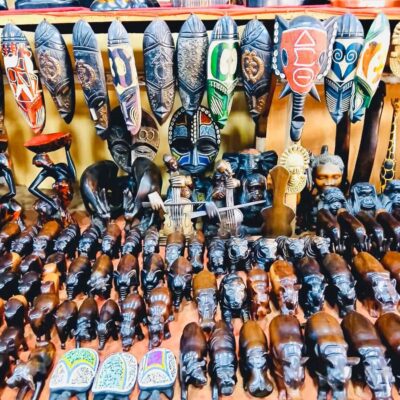
Browse the lists this tour appears in